
Why Grand Rapids basements grow mold
West Michigan hands basements a year-round moisture cycle. In late winter and early spring, deep frost and a heavy snowpack melt into saturated ground, and that water pushes against foundation walls and up through the slab — hydrostatic pressure that finds every crack and cold joint. Through summer, warm, humid air pours down the stairs and condenses on block and poured walls that stay cool underground, leaving them damp enough to feed mold on the paper face of drywall, on stored cardboard, and along the bottom of finished framing. Add an aging sump pump, a downspout dumping next to the foundation, or grading that slopes toward the house, and you have the recipe behind most of the musty Grand Rapids basements we hear about.
The materials make it worse. Finished basements built in the boom years often have studs and drywall set right against the foundation with little or no capillary break, plus carpet and pad on a cold slab. Those are exactly the cellulose-and-fiber materials mold loves once they pick up moisture — and because it's a basement, nobody notices until the smell reaches the rest of the house.
Signs your basement mold is more than surface mildew
- A persistent musty or “old-house” smell that's strongest at the bottom of the stairs.
- Dark speckling on drywall paper, the back of paneling, or the bottom plate of finished walls.
- White, crusty mineral deposits (efflorescence) on bare block or concrete — a sign water is moving through the wall.
- Buckled baseboards, peeling paint, or carpet that stays cool and slightly damp.
- Allergy symptoms that ease when you leave the house and return when you come back.
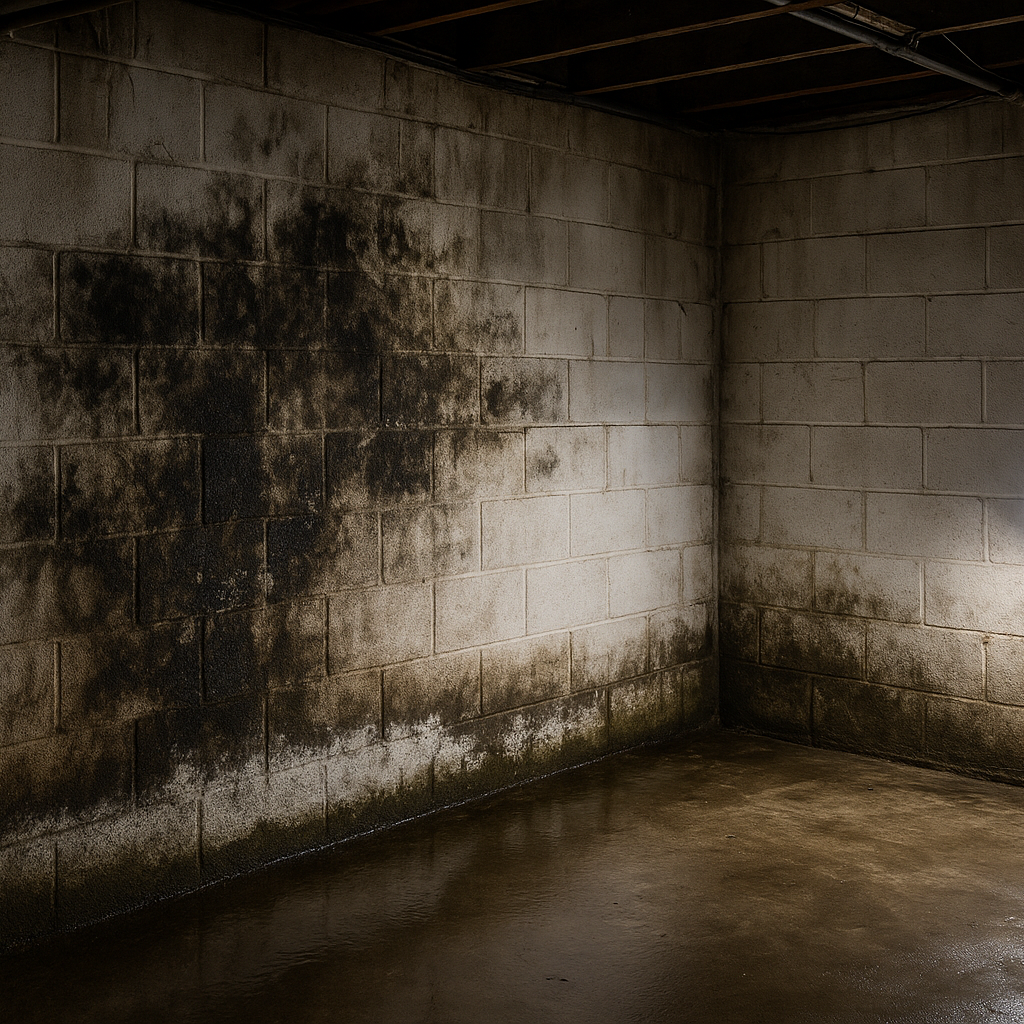
Mold along finished framing fed by a foundation seep.
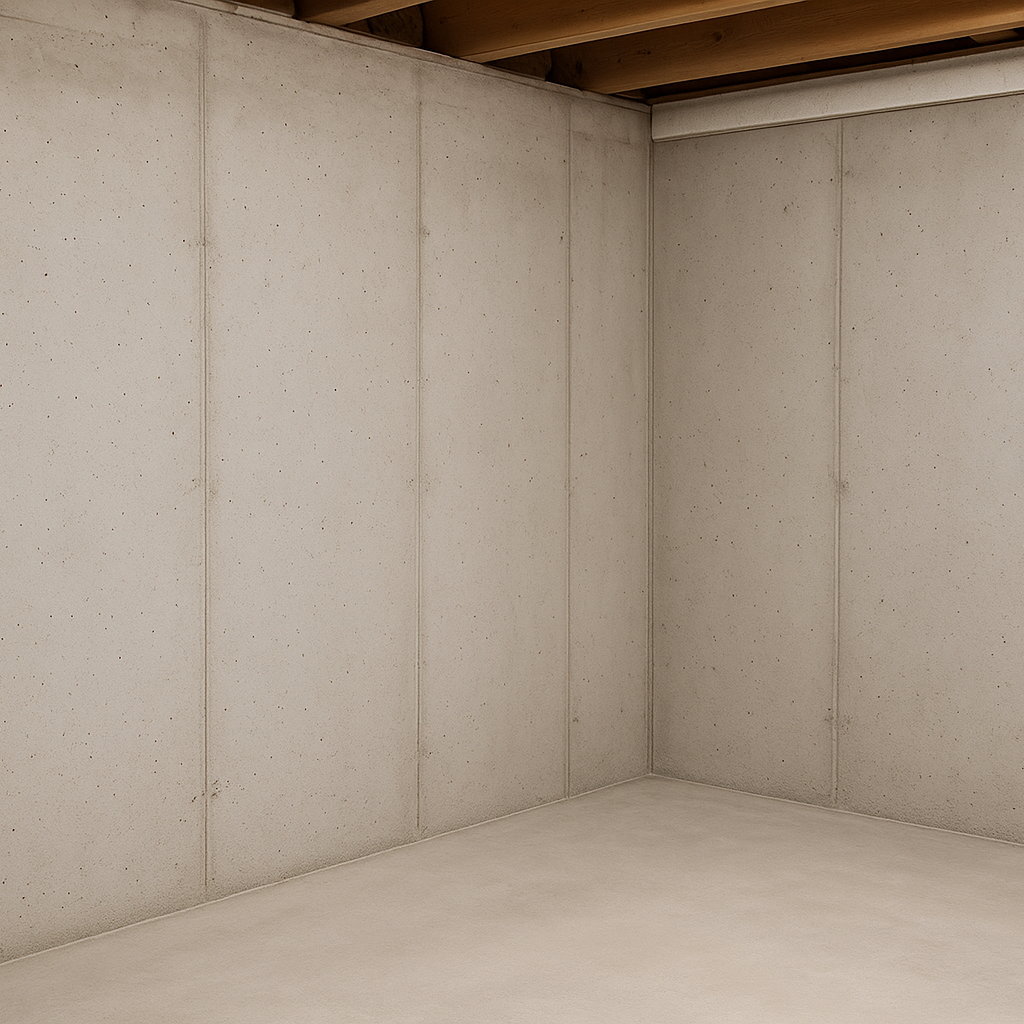
Affected materials removed, wall dried and rebuilt.
The containment-first removal process
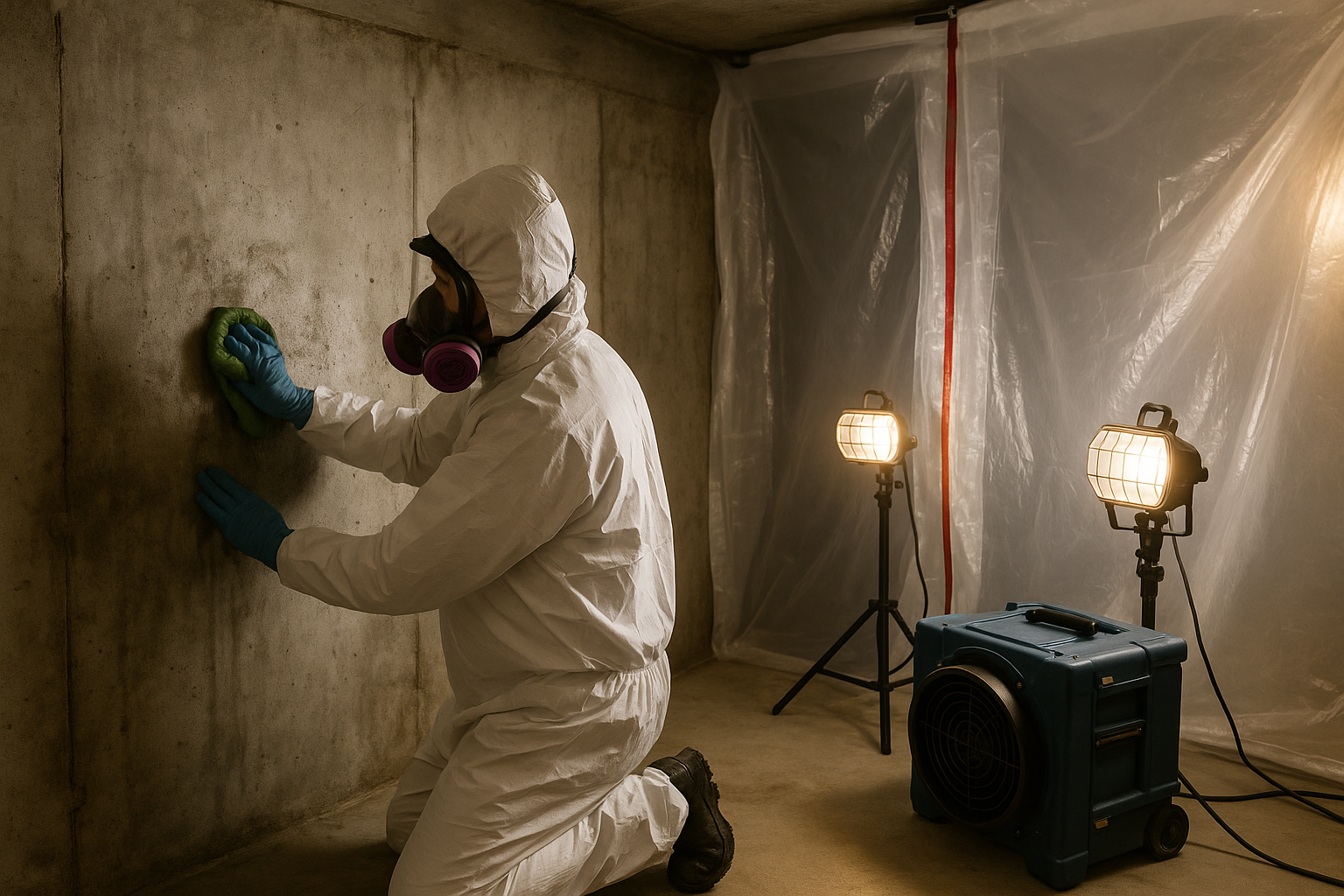
Done right, basement remediation isn't “spray and wipe.” A licensed crew works a sequence designed to keep spores from spreading through the ductwork to the rest of the house:
- Find and stop the water. Crack injection, exterior drainage or grading fixes, sump and drain-tile repair, dehumidification — removal is pointless while the wall is still getting wet.
- Contain the work area. Poly sheeting and a HEPA-filtered negative-air machine so demolition doesn't broadcast spores upstairs.
- Remove unsalvageable materials. Mold-laden drywall, insulation, carpet, pad, and paneling are bagged out; they can't be reliably cleaned once they've absorbed mold.
- Clean and treat structure. HEPA-vacuum and damp-wipe framing and masonry, then apply an EPA-registered antimicrobial.
- Dry to a verified target. Air movers and dehumidifiers until framing and slab hit a measured safe moisture content — not just “feels dry.”
- Rebuild smarter. Where it makes sense, mold-resistant materials and a capillary break so the next wet spring doesn't restart the cycle.
Skip the bleach. On porous basement surfaces, bleach is mostly water — it lightens the stain while the roots survive in the gypsum or wood and the moisture you just added feeds regrowth. Removal and drying beat bleaching every time.
What basement mold removal costs in Grand Rapids
A small, contained spot — one wall section, a closet, the area around a failed sump — often lands in the four figures. Once mold has spread across a finished basement with carpet, drywall, and framing involved, or once it's tied to a structural moisture problem like a failing drain tile, projects climb into five figures, especially when the fix includes foundation drainage or a new sump system. The price tracks the hidden moisture, not the visible patch. Sketch a ballpark with our cost estimator, then read the Grand Rapids cost guide for how pros actually price the work.
Keeping it from coming back
Remediation that ignores the water is a temporary fix. The lasting solution pairs removal with moisture control: a reliable sump pump (ideally with a battery backup for the storms that knock out power), downspouts carrying roof water well away from the foundation, grading that slopes away from the house, and a properly sized basement dehumidifier holding humidity around 50%. Our guide on preventing basement and crawl-space mold walks through each step. If you've already had water down there, start with an inspection to map the source — then tell us what you're dealing with and we'll connect you with a licensed Grand Rapids pro for a free quote.
How a basement remediation actually runs
Once the moisture source is identified, the work follows a predictable arc. The crew seals the work zone with poly sheeting and runs a HEPA-filtered air scrubber under negative pressure so spores don't drift up the stairs into your living space. Porous materials that are saturated or visibly colonized — carpet and pad, the paper face of drywall, soaked insulation, warped paneling — come out and get bagged at the source. Structural wood and block get HEPA-vacuumed and wiped, and where staining has set into framing, the crew sands or uses an appropriate antimicrobial rather than just painting over it.
Drying is the step homeowners underestimate. Commercial dehumidifiers and air movers run for days to pull the moisture out of concrete and framing, because mold that's wiped away on a Tuesday comes back by the weekend if the relative humidity stays high. Only after the materials read dry on a meter does rebuild begin — and a good contractor rebuilds smarter, leaving a capillary break between framing and foundation, using mold-resistant materials near the slab, and keeping the bottom of finished walls off the concrete.
Keeping it gone after the crew leaves
Remediation buys you a clean slate; moisture control keeps it. For Grand Rapids basements that usually means a sump pump with a tested battery backup ahead of spring thaw, downspout extensions that carry roof water six feet from the foundation, regrading low spots, and a basement dehumidifier set to hold humidity around fifty percent through the humid months. Many homeowners add a dedicated dehumidifier plumbed to the sump and a hygrometer they can glance at on the stairs. These are small costs next to a second remediation, and they're the difference between a one-time fix and a recurring headache.